Quick answer: a lower average still leaves market risk
Averaging down in crypto means buying more of an asset below your existing average acquisition cost. The new coins change the weighted average of the holding. Scheduled Dollar-Cost Averaging, or DCA, buys at time intervals; price-based buying waits for a decline. Automation can apply either rule, but they are different entry conditions.
Every extra purchase uses capital and increases the quantity exposed to the asset. A lower average does not create profit or protect against another fall. This guide uses educational examples, not historical TradeMatic results, and separates a portfolio calculation from the bot’s individual BUY→SELL cycles.
What changes when you average down?
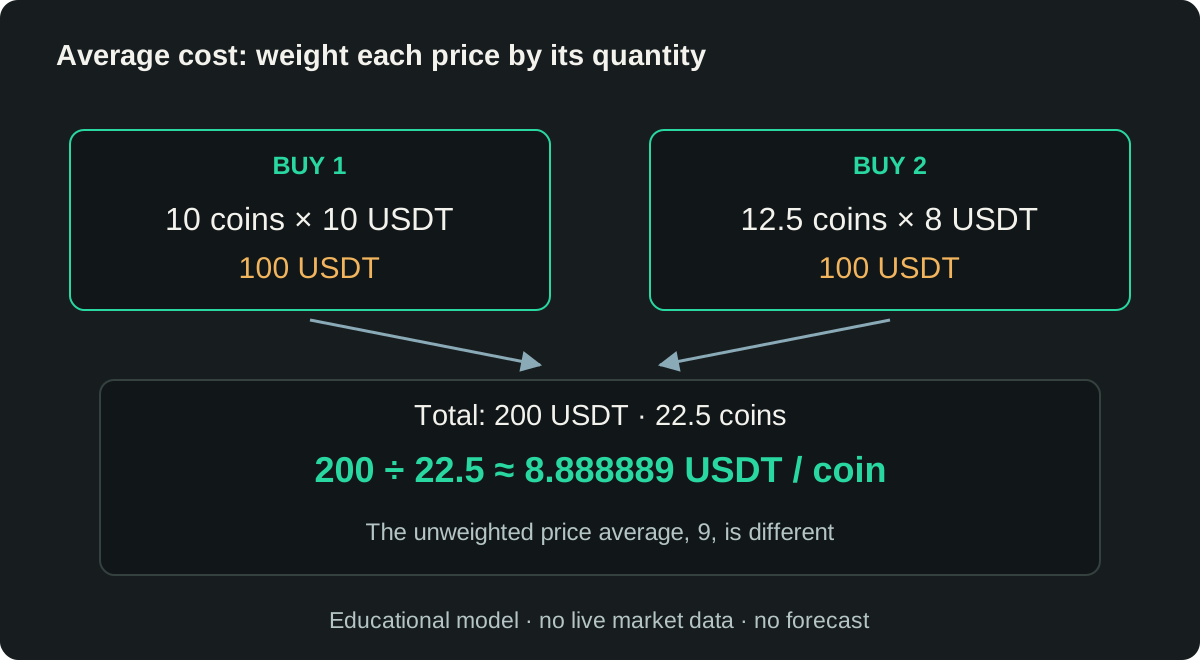
Suppose you buy 10 coins at 10 USDT, spending 100 USDT. Later, another 100 USDT buys 12.5 coins at 8. You now hold 22.5 coins with a total acquisition cost of 200 USDT. Before fees, the average is 200 ÷ 22.5 ≈ 8.888889 USDT per coin.
The simple average of the two prices is 9, which is wrong here: the quantities differ. The cheaper purchase contributed more coins. An average is a cost measure, not a cash payment from the exchange. If the market remains at 8, the holding is worth 180 USDT before sale fees, below its 200 USDT cost.
These are analytical cost-basis calculations, not tax accounting advice. After sales, the remaining inventory cost must reflect quantities already disposed of; dividing all historical spending by the coins left would misstate the remaining holding.
Classic DCA: buy the same budget on a schedule
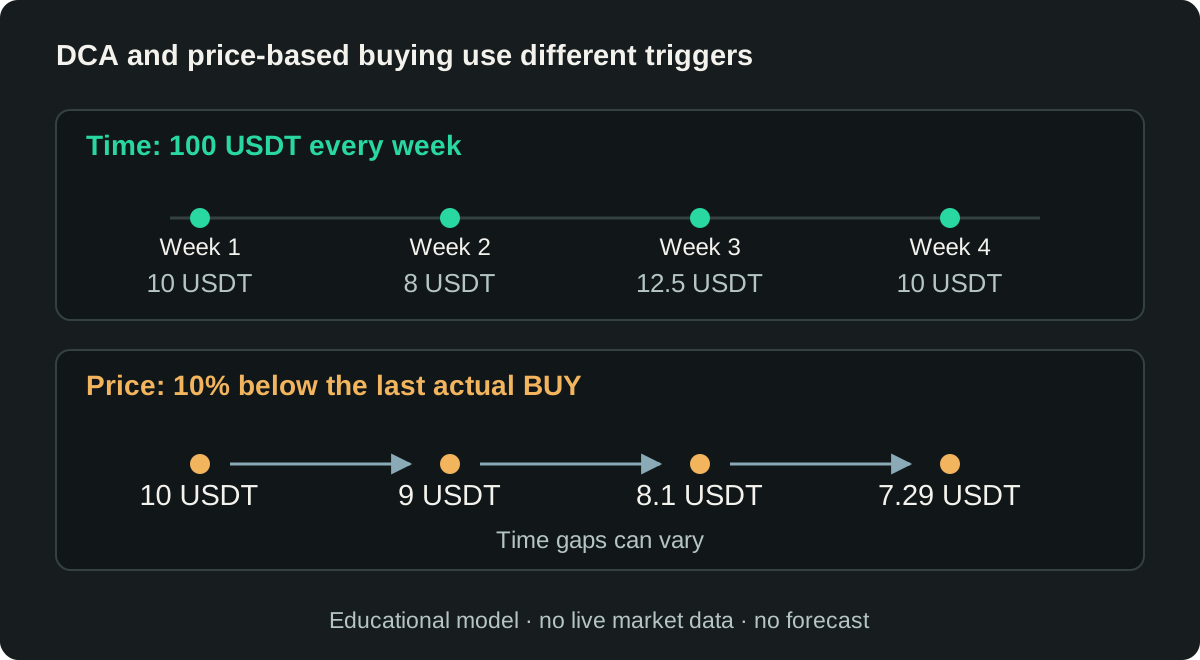
A classic example is 100 USDT each week, independent of short-term price direction. At prices of 10, 8 and 12.5 USDT, that budget buys 10, 12.5 and 8 coins respectively, before fees. Purchases can therefore occur during rises as well as declines.
A schedule can make contributions more consistent and reduce the need to choose a single entry moment. It does not guarantee a better outcome than investing once: during a sustained rise, later purchases may cost more. During a long fall, scheduled accumulation still acquires a declining asset.
Bybit’s native DCA Bot documents an investment amount and time interval. Its setup guide describes a first investment after successful creation, followed by scheduled purchases. If funds are insufficient, the schedule can be suspended and resume at a later scheduled purchase after replenishment. These are that product’s rules, not a description of TradeMatic’s trigger. See the official DCA introduction, FAQ and setup guide.
Price-based buying: define the reference and the budget
A price condition makes an additional purchase eligible when a specified decline occurs. Before calculating it, identify the reference: initial price, portfolio average, a peak, or the last actual purchase. Different references produce different orders.
Fixed levels 10%, 20%, 30% and 40% below an initial 10 are 9, 8, 7 and 6. Sequential 10% declines from each new purchase instead give 9, 8.1, 7.29 and 6.561, assuming fills exactly at those levels. These ladders are not interchangeable.
Position sizing is another independent choice. A fixed 100 USDT buys more coins as price falls; a fixed 10 coins uses fewer USDT. Increasing each purchase budget makes capital demand grow faster. The doubling example below is a theoretical model, not a TradeMatic feature.
DCA vs averaging down: compare the entry rules
| Criterion | Scheduled DCA | Price-based buying |
|---|---|---|
| Trigger | A scheduled time | A configured decline from a stated reference |
| Price dependence | Budget remains scheduled when price rises or falls | The price condition must be satisfied |
| Time dependence | Regular intervals | Irregular signals; a delay can also restrict execution |
| Frequency | Defined by the schedule | Depends on market movement and safeguards |
| Capital demand | Contributions accumulate over time | Many entries can become eligible during a rapid decline |
| Stopping | Product settings, funding and user action | Configured controls, funding, safeguards and user action |
| Long decline | Continues accumulating if funded and enabled | Successive decline levels can require more capital |
| Long rise | Can keep buying at higher prices | A decline condition might not occur |
| Market risk | The acquired asset can lose value | Growing concentration can magnify losses |
| Purpose | Time-distributed accumulation | Rules for entering after price changes |
Some products use “DCA” broadly for averaging tools. Inspect their actual trigger and sizing rules rather than treating the label as proof of identical behaviour.
Calculate a weighted average, with consistent units
Without fees or disposals, AveragePrice = TotalCost / TotalQuantity. Cost is in USDT, quantity in coins, and the answer in USDT per coin. For multiple fills, AveragePrice = Σ(Price_i × Quantity_i) / ΣQuantity_i, where each price and quantity belong to the same fill.
For N purchases with an identical quote budget B and no fees, AveragePrice = (N × B) / Σ(B / Price_i). Equal budgets are not equal coin quantities. If budgets differ, sum the actual costs and actual quantities instead.
For example, 100 USDT at 10 and 200 USDT at 8 acquire 10 and 25 coins. The average is 300 ÷ 35 ≈ 8.571429. It is neither the unweighted price average nor the result of the equal-budget example.
Use unrounded execution values internally. A six-decimal display is for reading, not another input into the calculation. Exchange quantity steps can reduce a submitted quantity; fees can reduce coins received. Replace idealised values with confirmed fills before calculating an actual holding.
Five purchases after successive 10% declines
This model spends 100 USDT at each of five prices, with no fees or sales. Each later price is the previous price multiplied by 0.9. It assumes exact fills at the threshold solely to make the arithmetic visible.
| Buy | Price, USDT | From previous | Spent, USDT | Coins bought | Total cost, USDT | Total coins | Average, USDT/coin |
|---|---|---|---|---|---|---|---|
| 1 | 10 | Initial | 100 | 10.000000 | 100 | 10.000000 | 10.000000 |
| 2 | 9 | −10% | 100 | 11.111111 | 200 | 21.111111 | 9.473684 |
| 3 | 8.1 | −10% | 100 | 12.345679 | 300 | 33.456790 | 8.966790 |
| 4 | 7.29 | −10% | 100 | 13.717421 | 400 | 47.174211 | 8.479209 |
| 5 | 6.561 | −10% | 100 | 15.241579 | 500 | 62.415790 | 8.010793 |
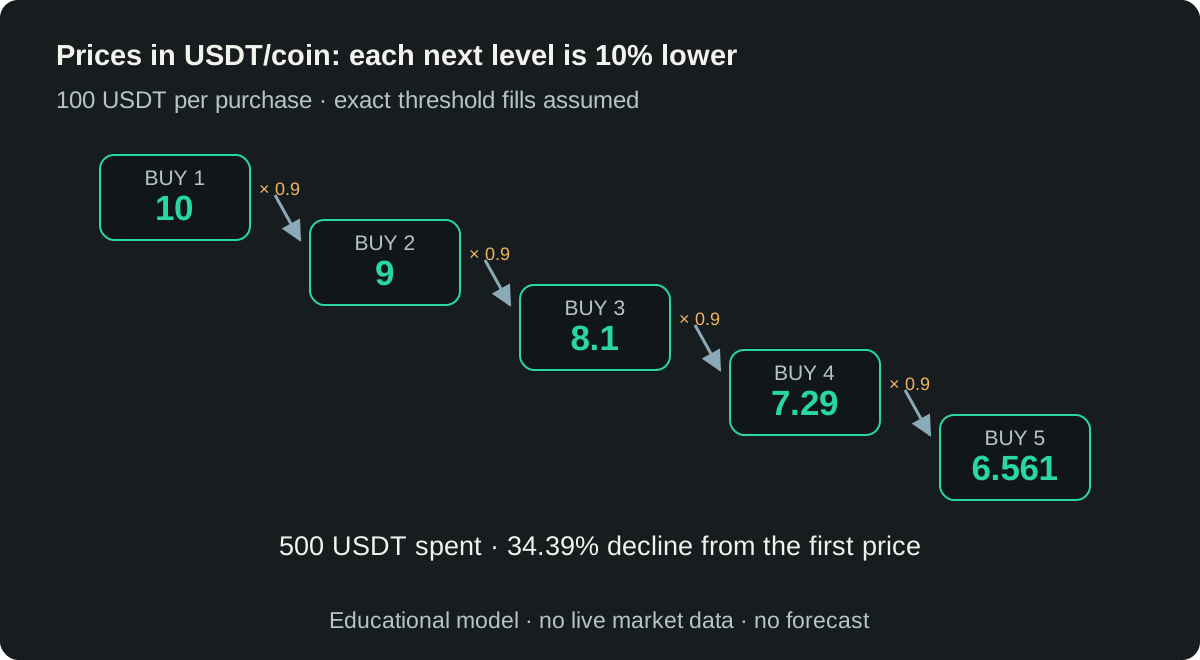
A market BUY may fill below or above the triggering quote. If the last actual fill differs, a strategy referenced to that fill must recalculate from it. The displayed ladder is not a promise of future trade prices or a request to buy missed levels in a batch.
Fees change the quantity and break-even price
Use the earlier two purchases, 100 USDT at 10 and 100 at 8. Assume a hypothetical 0.1% BUY fee deducted in the base coin on each fill, followed by a 0.1% SELL fee in USDT. Actual Bybit rates depend on the account, market and current conditions; these figures are a teaching assumption.
| Item | First BUY | Second BUY | Total |
|---|---|---|---|
| Quote spent, USDT | 100 | 100 | 200 |
| Gross coins | 10 | 12.5 | 22.5 |
| BUY fee, coins | 0.01 | 0.0125 | 0.0225 |
| Net coins | 9.99 | 12.4875 | 22.4775 |
The acquisition cost per net coin is 200 / 22.4775 ≈ 8.897787. Including an eventual SELL fee s, the theoretical break-even price is TotalCost / (NetQuantity × (1 − s)): here 200 / (22.4775 × 0.999) ≈ 8.906693. The displayed value is rounded, not an executable break-even limit.
At a full sale price of 9, gross proceeds are 202.2975 USDT, SELL fee 0.2022975, and net proceeds 202.0952025. The realised result for this fully sold model is +2.0952025 USDT. BUY fees already reduced the coins; adding them again as a new USDT debit would double-count them.
A Market BUY takes liquidity. A Limit SELL can be maker or taker depending on execution. Actual fills, partial quantities, fee currencies and rounding determine the result; an estimated fee rate or target price does not. Read the limit-selling guide for execution details.
How much capital do repeated purchases use?
| Number of buys | Budget each | Total required |
|---|---|---|
| 5 | 20 USDT | 100 USDT |
| 10 | 20 USDT | 200 USDT |
| 20 | 20 USDT | 400 USDT |
| 50 | 20 USDT | 1,000 USDT |
If one 20 USDT purchase has already happened, a five-purchase plan needs 80 more, not another 100 on top. Conversely, five additional purchases after an initial one would make six purchases in total. Separate used capital from money still needed.
A theoretical doubling sequence, 20, 40, 80, 160 and 320 USDT, consumes 620 USDT over five purchases. The cumulative totals are 20, 60, 140, 300 and 620. For N such purchases, TotalBudget = FirstBudget × (2^N − 1). This exponential funding demand is not the fixed purchase amount configured in TradeMatic.
In the five-by-100 ladder, a starting 1,000 USDT leaves 500 free after spending 500, assuming no other reservations or cash flows. The acquired coins are not another 500 USDT of free buying power. Coins reserved by open sells cannot also be committed to a second sale; they remain exposed until sold.
A long decline can overwhelm the lower average
First isolate market risk: hold just the initial 10 coins purchased for 100 USDT, without fees or further buys. At prices 9, 7, 5 and 2, the position is worth 90, 70, 50 and 20 USDT: unrealised losses of 10%, 30%, 50% and 80%. These are scenarios, not price forecasts.
Now use the completed five-buy ladder. At its fifth price, 6.561, the 62.415790… coins are worth 409.51 USDT against 500 spent: an unrealised loss of 90.49, or 18.098%, before exit fees. Their average fell to 8.010793, but they are not profitable.
| Later price | Inventory value, USDT | Unrealised result vs 500 |
|---|---|---|
| 6.561 | 409.510000 | −90.490000 |
| 5 | 312.078951 | −187.921049 |
| 2 | 124.831581 | −375.168419 |
A recovery from 2 to 5 is substantial but still leaves this inventory below cost. A recovery might never occur. Keep quote balance, inventory value, reserved coins, remaining cost and realised cash results distinct.
For a separate illustrative account, +10 USDT realised from completed sales and −100 unrealised on remaining inventory give a combined trading result of −90 before other costs. Green completed orders do not prove a profitable whole account. Do not count reserved coins twice as both available coins and another asset.
TradeMatic uses actual BUY prices and separate linked sells
The current Bybit Global Spot implementation uses a market BUY with a USDT budget. Its baseline becomes the latest actual BUY average for that pair, derived from executed quote and quantity. A further drop threshold is LatestActualBuyPrice × (1 − DropPercent / 100). It does not require a price rebound before another lower step.
- Initial BUYConfirm fills and the acquired lot
- Linked SELL APlan its own target and quantity
- Price conditionDecline from the last actual BUY
- Admission checksRUN, delay, funds and execution safety
- Additional BUYConfirm a new actual price and lot
- Linked SELL BTrack this purchase’s separate exit
A threshold crossing is eligibility, not a guaranteed order. Current intent, the timer, permissions, subscription eligibility, available funds, pair rules, ownership and duplicate/uncertainty safeguards still apply. A shortage of available USDT prevents that entry; it does not justify a smaller unrequested purchase or imply the condition never occurred.
Confirmed fills and fees determine acquired quantity; a fee in base reduces it. The sell planner applies target growth and fee-rate adjustments to that purchase’s actual price, then exchange precision and minimums. Partial fills must be reconciled with their remaining obligations. A reported FILLED status does not by itself guarantee that every fee and profit calculation is already complete.
Separate BUY operations have linked SELLs. A combined average can describe inventory analytically, but TradeMatic does not automatically merge every purchase into one sell priced from that average. Its trigger compares with the latest BUY, not the portfolio average, so an eligible purchase does not necessarily lower the aggregate average. It does not treat unrelated existing account coins as its own purchased lots.
Only full execution of the latest confirmed own SELL of the active pair can authorise one continuation, with current entry checks. It can be a sell from a drop buy. Older or inactive-pair sells remain accounted for without independently starting another BUY.
STOP blocks new entries, not all exchange activity. A BUY already dispatched can still complete and receive its linked SELL. Existing sells remain on Bybit; fills and accounting continue. They are not all cancelled by stopping. See the algorithm and controls.
Understand the settings before enabling a rule
In Telegram, /settings shows the configuration; /pair chooses the asset, /summ sets a purchase’s USDT budget, /dropthreshold sets the decline and /growththreshold sets target growth. /timerseconds sets the purchase delay. /start and /stop express the user’s trading intent, subject to current eligibility and safety checks.
A valid connection needs the required Spot permissions and applicable subscription access; RUN alone cannot supply missing credentials or funds. This article neither selects settings for you nor provides an API-secret form. Review the API connection guide and subscription terms. The bot comparison explains how native scheduled DCA differs from this implementation.
Execution and operational limits still matter
Low liquidity, slippage and partial fills can change actual entries. Minimum order value, quantity precision, price ticks and exchange price protections can prevent an otherwise intended order. API limits, server outages or a disconnected stream can interrupt the path between signal and confirmed execution.
Open limit sells may wait indefinitely while inventory falls. Repeated purchases increase concentration in one asset and reduce liquid USDT. Incorrect settings can amplify this exposure. Automation does not remove these risks or establish that funds will cover every future step.
Situations that deserve particular caution
A plan with no defined funding boundary becomes difficult to sustain when declines cluster. A small USDT reserve, a very volatile asset or a large existing concentration makes that problem more acute. Doubling budgets can exhaust funds far sooner than a fixed-budget plan.
Unfamiliar fee currencies, long-lived unfilled sells and a habit of judging performance only from closed trades can also distort the picture. Before interpreting a lower average as progress, inspect the larger quantity at risk and the capital still available. This is general education, not personalised investment advice; read the risk disclosure.
Read the average alongside capital and exposure
A weighted average describes acquisition cost. The time or price rule determines when additional coins are bought. Fees and fills determine what was actually acquired, and future prices determine its market value. TradeMatic automates a particular price-based rule with separate linked exits; it does not turn a falling average into guaranteed income.
Frequently asked questions
What does averaging down mean in crypto?
It means acquiring more of an asset below your existing average cost. The weighted average can fall while the total quantity, committed capital and possible loss grow.
Is averaging down the same as DCA?
No. Classic DCA follows a time schedule. Price-based averaging waits for a specified decline; product labels can use DCA more broadly, so check the actual rule.
How do I calculate my average purchase price?
Divide the acquisition cost of the inventory by its quantity, using consistent units and fee treatment. For differing quantities, do not simply average the displayed prices.
Can I automatically buy crypto when price drops?
Yes, an automation service can implement a price condition. A signal still needs funding, valid permissions, current user intent and execution checks.
Does averaging down guarantee profit?
No. A lower cost per coin does not guarantee recovery or a completed sale. A larger inventory can lose more money during a continuing decline.
What happens if crypto keeps falling?
More purchases consume USDT and increase exposure; without further purchases, existing coins can still lose value. Funds can run out before any recovery occurs.
How do fees affect the average?
A base-asset purchase fee reduces net coins. A later quote-asset sale fee reduces proceeds. Account for both without charging the same fee twice.
How much USDT should be reserved for additional buys?
There is no universal safe amount. Distinguish total planned purchases from additional ones and subtract budgets already spent; market path, fees and other obligations matter.
Does TradeMatic combine all buys into one averaged sell?
No. Its current path links sells to individual own BUY operations. An analytical portfolio average does not automatically set every sell price.
Does stopping TradeMatic cancel existing orders?
No. STOP prevents new entries; existing sells remain, and an already dispatched BUY can still receive its linked SELL. Their real executions continue to be accounted for.
Official sources and scope
Official Bybit documentation checked on 13 November 2026. The order examples are hypothetical, not live trades. TradeMatic behaviour was checked against current source code without accessing accounts or placing orders.