What is the difference between Bybit Spot Grid and DCA Bot?
Bybit Spot Grid trades price levels; Bybit DCA buys on a timetable. Spot Grid places buys and sells across a selected range, seeking completed cycles as prices fluctuate. DCA repeatedly spends a chosen amount to accumulate coins, whether the next scheduled price is lower or higher. Neither rule guarantees a profitable holding.
| Question | Spot Grid | DCA Bot |
|---|---|---|
| Main trigger | Price reaches grid orders | A scheduled investment time |
| Main purpose | Repeated buy/sell cycles | Regular accumulation |
| Main exposure | Inventory and range selection | Growing inventory and funding needs |
| Separate bot subscription | None; trading fees apply | None; trading fees apply |
This comparison concerns Bybit Global Spot, not Futures Grid, leveraged contracts or a backtested promise. The examples use an invented ABC token and hypothetical fees.
Two native tools, two different decisions
Native bots run inside the exchange account and use funds allocated to their strategy. They are different from an independent API service such as TradeMatic. Grid receives its initial allocation from Funding; DCA draws the required investment from Funding for scheduled purchases. Money assigned to a bot is not simultaneously available for another strategy.
On Spot, a falling coin can lose value without futures liquidation being involved. Account access, product availability and exchange execution still matter. Automation removes repeated manual actions; it does not remove the decision about which asset to hold.
How Bybit Spot Grid works
A setup specifies a supported pair, lower and upper prices, the number of grids and investment. Orders divide that price range into levels. A filled buy can lead to a sell at the next level; a completed sell can make room for a later buy. The bot also needs starting inventory for sell orders, so an allocation can include an initial coin purchase rather than consist entirely of waiting USDT orders.
The current official Spot Grid material describes arithmetic spacing: equal price differences. Geometric spacing means equal percentage ratios, but it is not a verified selectable mode in this Spot flow; features from Futures Grid should not be imported into it.
Without a special setting, moving outside the configured range pauses new grid orders until price returns. Below the lower boundary, the bot can be left holding depreciating coins. Above the upper boundary, selling inventory can limit participation in further gains.
Trailing Up and exit settings
Optional Trailing Up can shift a grid upward, subject to its documented conditions, including at least five grids and sufficient available balance inside the bot. Its trigger is the upper limit plus one grid interval; the lowest buy is cancelled and a buy is added at the former upper limit. It does not trail down and can buy at higher prices. The ordinary fixed-range rule and this exception must be distinguished.
Spot Grid also documents TP/SL termination and an equity-based Trailing Stop. The documented TP lies above entry and the upper boundary; SL lies below entry and the lower boundary. A triggered TP/SL terminates the bot and converts base to quote. These are not guaranteed execution prices: termination, conversion and market liquidity can affect the final amount. Check the current confirmation screen rather than assume that every setting preserves the original range indefinitely. Official setup instructions describe the controls.
A complete educational grid example
Take ABC/USDT at 100, a range of 90–110 and five price levels: 90, 95, 100, 105, 110. They make four intervals, each 5 USDT apart: (110 − 90) / 4 = 5. This is a teaching model, not Bybit's exact order-sizing algorithm or an eligible Trailing Up configuration.
| Part | Quantity or cash | Cost or reservation |
|---|---|---|
| Initial inventory at 100 | 2 ABC | 200 USDT spent |
| Possible buys at 95 and 90 | 1 ABC at each | 185 USDT reserved from cash |
| Possible sells at 105 and 110 | 1 ABC at each | Use the existing 2 ABC |
| Cash balance | 300 USDT | 115 free + 185 reserved |
The full budget is 500, not 500 plus reservations. An order reservation remains part of cash or inventory; it is not a second asset. An idealised move from 95 to 100 can complete a buy/sell cycle. A move below 90 creates no extra lower level in this fixed model.
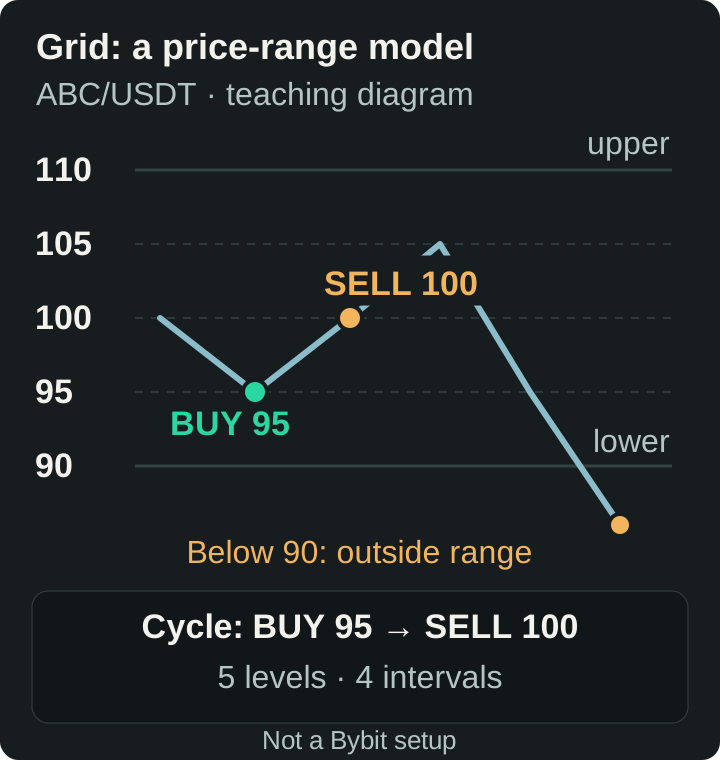
For a fully specified cycle, buy 1 gross ABC at 95. Assume a 0.1% fee in ABC: 0.001 ABC is deducted, leaving 0.999. Sell exactly that 0.999 at 100: gross proceeds 99.9 USDT, a 0.0999 USDT SELL fee and net proceeds 99.8001 USDT. Against 95 spent, the realised result is +4.8001 USDT. The fee-free one-coin cycle would earn 5; these are different quantity assumptions.
How Bybit DCA Bot works
DCA invests a fixed amount at repeated times. Current documentation supports choosing USDT or USDC as the investment currency of a bot and allocating to up to five purchase coins. The first investment starts at creation; later purchases follow the interval. A basket still needs a funding plan and does not guarantee diversification against every market decline.
Documented intervals include 10 minutes; 1, 4, 8 or 12 hours; one day; and 1, 2 or 4 weeks. Availability and minimums should be checked in the current product interface. DCA is not a price-drop detector: it can buy more units at a lower price and fewer at a higher one, but makes the scheduled decision in both cases.
A maximum investment limits cumulative spending. If its remaining allowance cannot cover another full scheduled amount, the strategy terminates under that rule. Insufficient Funding balance instead suspends buying, with resumption at a later scheduled time after funding is restored. Manual termination is documented; this is not a claim that the interface has a separate Pause button.
The current DCA setup does not document an automatic target sell for every purchase or the Spot Grid TP/SL controls. Termination offers handling of accumulated coins; check the available in-kind or conversion choice and its fees. Do not confuse ending future purchases with a guaranteed profitable exit. See the DCA FAQ for current investment conditions.
Four scheduled purchases: the weighted average
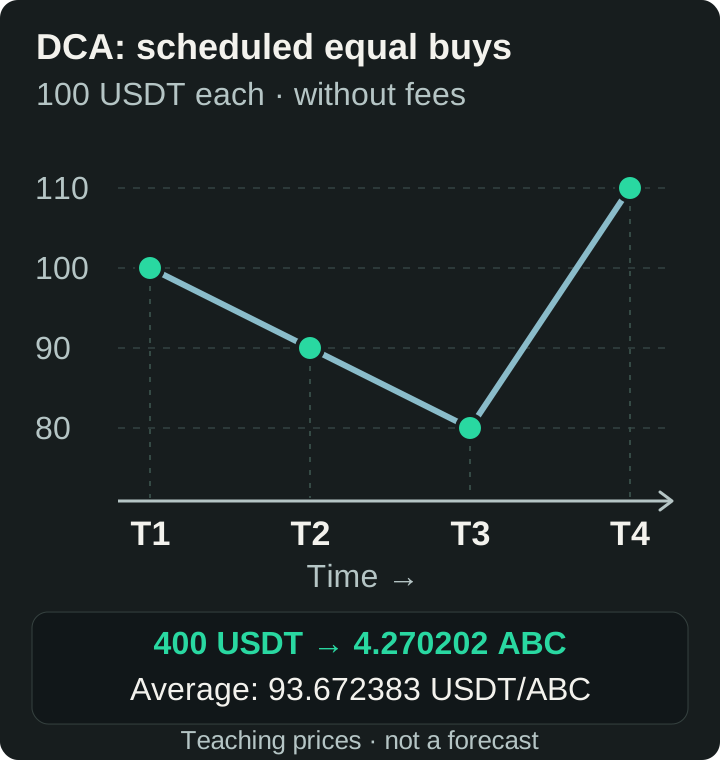
Spend 100 USDT at each scheduled price 100 → 90 → 80 → 110. Ignore fees initially. Equal quote budgets buy unequal coin quantities:
| Round | Price, USDT/ABC | Spent, USDT | ABC bought | Total cost, USDT | Total ABC | Average, USDT/ABC |
|---|---|---|---|---|---|---|
| 1 | 100.000000 | 100.000000 | 1.000000 | 100.000000 | 1.000000 | 100.000000 |
| 2 | 90.000000 | 100.000000 | 1.111111 | 200.000000 | 2.111111 | 94.736842 |
| 3 | 80.000000 | 100.000000 | 1.250000 | 300.000000 | 3.361111 | 89.256198 |
| 4 | 110.000000 | 100.000000 | 0.909091 | 400.000000 | 4.270202 | 93.672383 |
Total spending is 400 USDT; total coins are 4.270202… ABC. Cost per coin is 400 / 4.270202… ≈ 93.672383 USDT, not the simple mean of the four prices, 95. The difference comes from buying more units at the cheaper prices, not from a guaranteed discount to tomorrow's market.
With the same hypothetical 0.1% BUY fee taken in ABC at each investment, net inventory is 4.265932… ABC and cost per net coin approximately 93.766149 USDT. Spending remains 400 USDT: the base fee reduces quantity rather than adding another cash debit.
| Final mark | Value without BUY fees | Unrealised P&L | Value after base fees | Unrealised P&L |
|---|---|---|---|---|
| 110 USDT | 469.722222 | +69.722222 | 469.252500 | +69.252500 |
| 80 USDT | 341.616162 | −58.383838 | 341.274545 | −58.725455 |
All valuation results are USDT and rounded for display. None is realised proceeds. A rising sequence can raise the acquisition average; DCA does not promise a better entry than every alternative.
Spot Grid vs DCA: compare the operating rules
| Criterion | Bybit Spot Grid | Bybit DCA Bot |
|---|---|---|
| Purpose | Price-level trading cycles | Scheduled accumulation |
| BUY trigger | Grid order execution | Scheduled investment |
| SELL trigger | Grid sell levels | No documented per-buy target sell |
| Time intervals | Not the normal entry trigger | A core setting |
| Price range | Lower and upper bounds | No grid range in this setup |
| Orders | Multiple buys and sells | Purchases across scheduled rounds |
| Main parameters | Pair, range, grids, allocation, exits | Coins, amounts, interval, investment cap |
| Market assumption | Tradable oscillations within the rules | Desired long-term exposure |
| Sideways market | Can complete repeated cycles | Continues purchases |
| Rising market | Upper bound; optional Trailing Up | Buys fewer units per equal budget |
| Falling market | Can accumulate coins below cost | Buys more units; exposure grows |
| Capital | Upfront allocation and reservations | Recurring funding requirement |
| Accumulation | Inventory changes with executions | Main design objective |
| Realised result | Completed cycles, after costs | Purchases alone realise no sale profit |
| Unrealised result | Remaining coins change in value | Accumulated coins change in value |
| Trading fees | Spot fees on executions | Spot fees on executions |
| Bot subscription | No separate native bot fee | No separate native bot fee |
| TP/SL | Documented termination settings | Not documented in this DCA flow |
| Stopping | Manual or configured termination | Manual or investment-cap termination |
| Main limit | Range, sizing and execution constraints | Funding, schedule and coin availability |
| Main risk | Inventory loss can exceed cycle gains | Persistent decline in an expanding holding |
Four market scenarios, without a return forecast
A. Sideways trading
Repeated crossings can allow a grid to buy lower and sell higher. Narrow movement that never reaches the next executable level creates no completed cycle. Fees can consume small spreads. DCA keeps purchasing on its dates; it need not realise any profit from those oscillations because a purchase is not a sale.
B. Persistent growth
A fixed grid can sell inventory and reach its upper boundary, missing later appreciation compared with simply retaining the same coins. Trailing Up changes that path under its conditions, not for free or without new risk. DCA keeps spending its scheduled budget at higher prices, receiving fewer coins. Neither comparison establishes which future path will occur.
C. Persistent decline
Grid buys can turn cash into inventory before price falls below the lower boundary. Pausing new orders there does not undo the holding's loss. DCA may acquire more units per payment while committing still more cash to the declining asset. Both can show a lower average and a larger absolute loss at the same time.
D. Volatility and a range breakout
A fast round trip can fill several orders, but a gap, low liquidity or an incomplete fill can make the actual sequence differ from a tidy diagram. A breakout can end the in-range cycling opportunity. More trades mean more fee-bearing executions; past cycle counts alone say nothing certain about future net results.
Why positive Grid Profit can coexist with negative Total P&L
Bybit's Grid Profit measures completed grid-cycle results. Its Total P&L also reflects the value of remaining base coins and balances. A realised sale result and an unrealised inventory revaluation answer different questions. The interface's Current P&L is Total P&L minus cumulative withdrawn Grid Profit; compare figures with consistent withdrawal and funding treatment.
Use the earlier 500 USDT model. Keep the original 2 ABC with a cost of 200. Complete the fully specified cycle for +4.8001. Cash is now 300 − 95 + 99.8001 = 304.8001. Cancelled or absent reservations in this valuation example do not change cash ownership.
If ABC is marked at 80, the remaining 2 ABC are worth 160: an unrealised loss of 40. Equity is 304.8001 + 160 = 464.8001 USDT; overall trading result is −35.1999 USDT, also +4.8001 − 40. Positive completed-cycle profit has not protected the initial inventory.
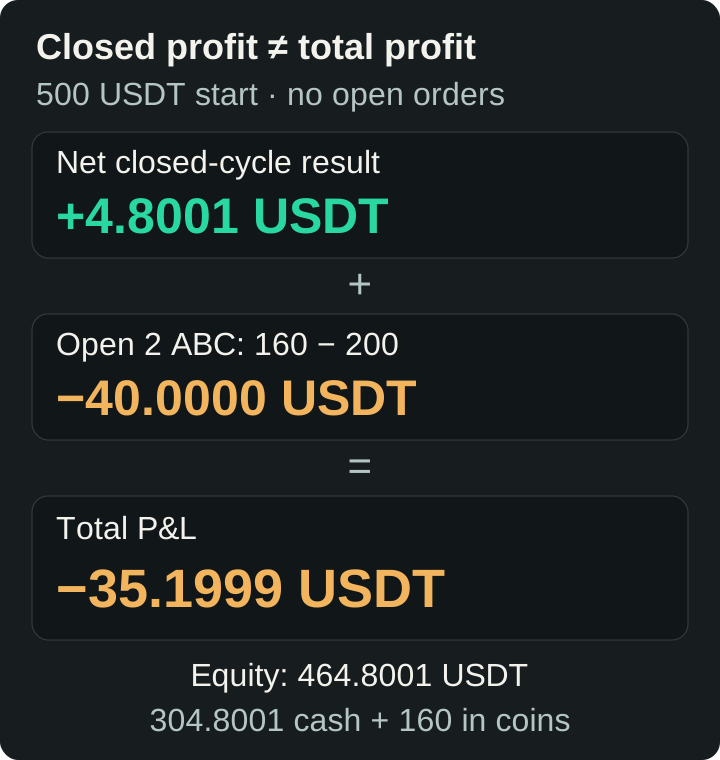
Sale turnover is not profit; an order's quoted target is not realised cash. This model omits startup fees, further cash flows and an eventual inventory exit fee. Bybit's actual metrics must be read with its official P&L definitions, not inferred from one green counter.
Bot access is free of subscription, executions are not
The native Grid and DCA FAQs describe no separate bot creation or subscription charge, while the relevant Spot trading fees still apply. Actual rates depend on the account's fee tier and current pair conditions. A market buy takes liquidity; an executable limit order is not automatically a maker fill. Check the rate applying to the account rather than treat our 0.1% assumption as a universal tariff.
The cycle above specifies both fee currencies. The 0.001 ABC purchase fee reduces coins available to sell; the 0.0999 USDT sale fee reduces proceeds. Do not debit that base fee again as additional USDT spending. Frequent grid executions can accumulate fees even when individual order amounts appear small. DCA fees also reduce the assets accumulated. The Spot fee explanation and account fee schedule provide the current rules.
Capital is a plan, not a universal minimum
Grid funding depends on the pair, exchange minimums, range and order count. Splitting a small budget into many levels can leave individual orders below requirements. Our 500 USDT allocation is an example, not Bybit's minimum.
For DCA, four 100 USDT rounds need 400 nominal USDT; four more require another 400. Coins already bought are not the same as free quote balance. Include outstanding orders, fee effects and other uses of the account when checking available funds. A bot's ability to continue must not be inferred from the total market value of its inventory.
Native does not mean risk-free
Protect account access and review supported markets and product availability. Wrong parameters, insufficient funds, service interruptions and exchange-rule changes can interrupt automation. A conversion on termination may realise a loss and incur fees or slippage. An open holding can remain underwater for an extended period. Spot without borrowing is different from a leveraged product, but it still exposes the committed capital to loss.
Where TradeMatic differs from Grid and scheduled DCA
The current TradeMatic Bybit path submits a market BUY using a USDT budget, confirms actual execution and plans a separate linked limit SELL. The sell target uses that purchase's actual price, target growth, estimated fee adjustments and exchange precision. Confirmed quantities and fees determine accounting; a planned target is not promised realised profit.
A further purchase is evaluated against the latest actual BUY price for that pair: LastActualBuyPrice × (1 − DropPercent / 100). No preliminary rebound is needed. Current RUN intent, delay, funds, permissions, subscription eligibility, ownership and duplicate/uncertain-order safeguards still govern execution. This delay is not a calendar of recurring investments.
Only full execution of the latest confirmed own SELL pointer of the active pair can authorise one continuation, including a pointer originating from a drop purchase. An older or inactive-pair SELL remains accounted for without authorising its own new BUY. STOP prevents new entries; it does not guarantee that an already dispatched BUY or existing SELL disappears.
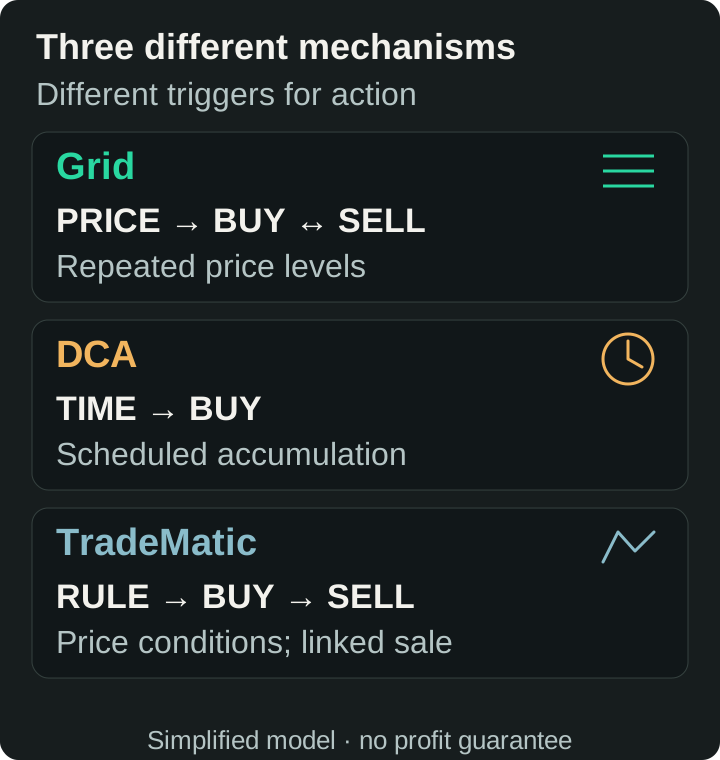
| Rule | Spot Grid | DCA | TradeMatic |
|---|---|---|---|
| BUY / SELL | Grid cycles | Scheduled buys | Budget BUY / linked SELL |
| Range | Explicit boundaries | No grid range | No classic fixed grid in this path |
| Schedule | Price-driven | Recurring interval | Event delay, not periodic DCA |
| Price decline | Grid buy levels | Not required | Configured decline from latest BUY |
| Fees | Execution costs | Execution costs | Target estimates; actual-fill accounting |
| Control | Bybit interface | Bybit interface | Telegram |
| Cycle model | Grid replenishment | Accumulation | Own lots and latest SELL continuation |
| Service cost | No separate subscription | No separate subscription | Paid subscription |
| Exit limits | Configured grid exits | No documented per-buy target | Limit sell, not native trailing/stop |
This implementation is not a full Grid Bot or a scheduled DCA replacement. It does not merge all purchases into one average-price exit, and unrelated pre-existing account assets do not become its own lots. Read the operating rules, subscription terms and API guide. The earlier service comparison covers a wider selection.
Choose the rule that matches the job
Buying BTC for 100 USDT each week regardless of price points toward scheduled DCA. Repeated buying and selling within explicit boundaries points toward Spot Grid. A configured decline followed by a separate target sale is closer to TradeMatic's price-based path, subject to its guards.
If minimising software subscription cost is the priority, the native tools have that advantage. If Telegram control is important, TradeMatic is one available approach, not the only possible Telegram solution. A user needing only standard DCA may not need an additional paid service. For the mathematics of repeated buys, see averaging and dip buying; for execution, see automatic limit selling.
Main risks when choosing a strategy
A strategy can be unsuitable for the market path, underfunded or configured more aggressively than its owner can sustain. High turnover, fees, growing concentration and unrealised losses can coexist with reassuring completed-trade statistics. Check current balances and obligations, not just a past return or the number of successful cycles. This article is education, not personalised financial advice; read the risk disclosure.
There is no universal winner
Spot Grid organises price-level trades. DCA organises purchases over time. TradeMatic implements a separate guarded entry-and-linked-exit workflow. Compare the intended task, funding, execution rules, access costs and risks; none of these mechanisms turns automation into guaranteed income.
Frequently asked questions
What is the difference between Bybit Spot Grid and DCA Bot?
Grid reacts to price levels with buy/sell cycles. DCA buys at scheduled times. One targets trading fluctuations; the other organises accumulation, with market risk in both.
Is Bybit Spot Grid free to use?
Its current FAQ specifies no separate bot creation/subscription charge. Spot execution fees still apply; free access does not mean fee-free trading or protection from losses.
Does Bybit DCA charge extra subscription fees?
The native DCA FAQ does not add a separate subscription. Purchases remain subject to applicable Spot fees, minimum amounts and account/product conditions.
Which bot is better for a sideways market?
Grid is designed to exploit repeated crossings, provided levels actually fill and spreads cover costs. DCA follows its schedule; neither is certain to profit from a sideways chart.
Can Spot Grid lose money?
Yes. Depreciation of retained coins, fees and exit execution can outweigh completed-cycle gains. Leaving the price range does not erase the existing exposure.
Does a positive Grid Profit mean overall profit?
No. Remaining inventory can have a larger unrealised loss. Examine Total P&L, balances and withdrawals on consistent terms rather than one completed-cycle metric.
Does DCA buy crypto when the price drops?
It may buy at a lower scheduled price, but a decline is not the trigger. It can also buy after a rise; the timetable and funding conditions decide.
Can I use Grid and DCA on Bybit Spot?
Both are native Spot tools where available. Supported coins, limits and funding requirements apply; allocating the same money to both does not create twice the buying power.
Is TradeMatic a Grid or DCA bot?
Its inspected Bybit path is neither a classic fixed grid nor scheduled recurring DCA. It uses guarded price-based purchases, individual linked exits and a latest-SELL continuation rule.
Can I automate Bybit trading through Telegram?
TradeMatic provides Telegram controls with a paid subscription and a suitable API connection. Permissions, funds, user intent and execution safeguards remain necessary; profit is not guaranteed.
Official sources and scope
Official Bybit documentation checked on 14 November 2026. The order examples are hypothetical, not live trades. TradeMatic behaviour was checked against current source code without accessing accounts or placing orders.
- Introduction to Spot Grid Bot
- FAQ — Spot Grid Bot
- How to Get Started With Spot Grid Bot on Bybit
- Profit & Loss Calculations — Spot Grid Bot
- Introduction to Dollar-Cost-Averaging (DCA) Bot
- FAQ — Dollar-Cost-Averaging (DCA) Bot
- How to Get Started with DCA Trading on Bybit
- Differences Between Bybit Trading Bots
- Bybit Spot Fees Explained
- Trading Fee Structure
- How Trailing Up Works in Spot Grid Bot
- Bybit Spot Grid Bot: Best Market Conditions